- In this article, we are intending to go about the task of how to quickly sort numerical data in Word documents. As you all know, excel can quickly sort data. However, are you aware of the fact that Word is capable of this task as well? In most cases, you may use Word to deal with text.
- Jan 01, 2006 2019 California Rules of Court. Contents and form of briefs (a) Contents (1) Each brief must: (A) Begin with a table of contents and a table of authorities separately listing cases, constitutions, statutes, court rules, and other authorities cited.
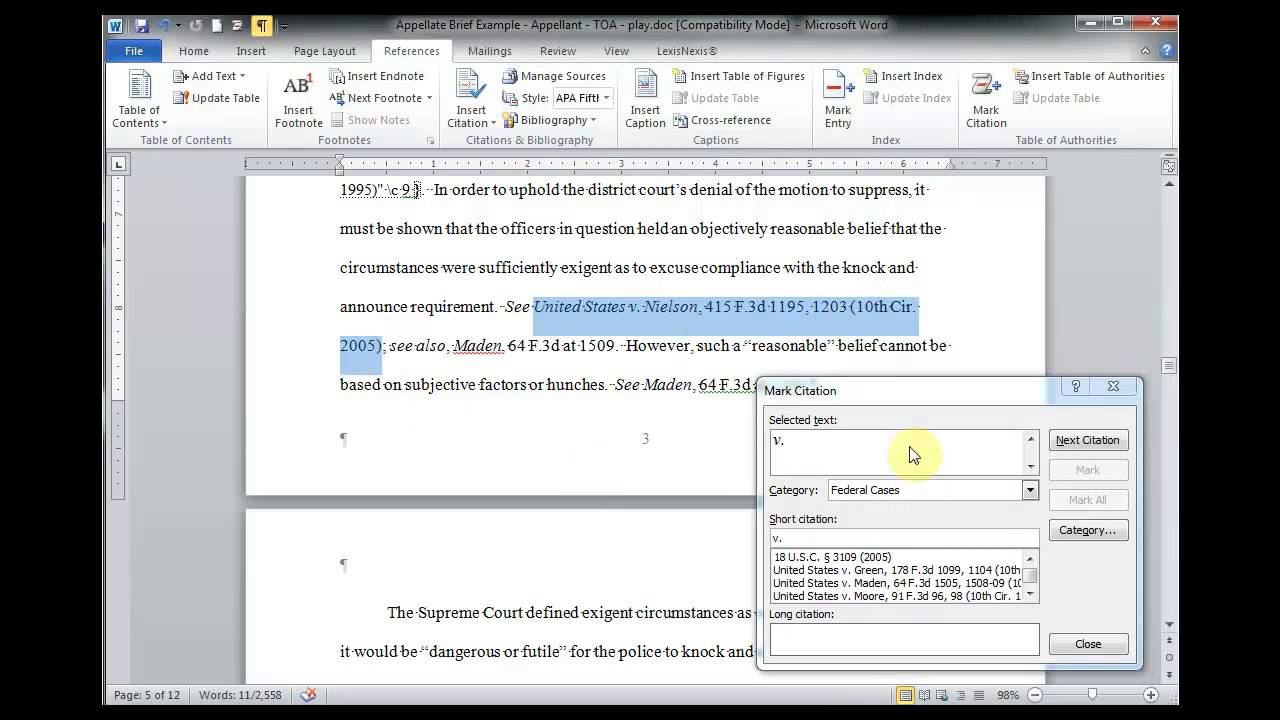 You can exclude the Table of Authorities pages in Lexis
By default, the table of contents in MS Word shows the first three heading levels. Here’s how you can customize heading levels shown in the Table of contents in MS Word. Create your document first and add the headings and sub-headings you need to give it structure.
®for Microsoft® Office (LMO) from the page numbering system provided by Microsoft® Word.The
Numbering Table Of Authorities 2016
Section Break feature in Word restarts the page numbering with 1 on the desired page 1. After inserting a section break, update the TOA by clicking on Update TOA and all the page numbers for the citations are automatically adjusted.Take the following steps to exclude your Table of Authorities pages from the document page numbering:
- Place your cursor on the first line of page you want to be page 1.
- Click Layout in the Word ribbon.
- Click Breaks.
- Click Next Page.
- Double click on the header area of page 1.
Note: The header area is the blank white space before the text begins. This action opens the header for editing and adds the Design ribbon. - Click Link to Previous in the Design ribbon.
Note: You may see 2 Design ribbons in Word. Use the Design ribbon on the right that includes options for the Header and Footer of your document. - Click the drop-down arrow by Page Number.
- Click Format Page Numbers.
- Select the Number Format you want for your document, such as 1,2,3,....
- Select Start at and enter 1 in the field.
- Click OK.
- If not already open, click Update TOA in the LexisNexis® ribbon to open the LexisNexis pane.
- Click Update TOA. The Table of Authorities in your document will update to include the updated page numbers.
- Remove any extra blank pages LMO inserted.
In this article, we are intending to go about the task of how to quickly sort numerical data in Word documents.
As you all know, excel can quickly sort data. However, are you aware of the fact that Word is capable of this task as well? In most cases, you may use Word to deal with text. Still, there can be numbers and tables containing numerical data in your Word document. Then, learning how to sort numerical data in Word comes to your top priority.
In the article below, we will focus on discussing sorting two forms of numerical data in Word document.
Sort Numerical Data in Tables
- First, select the column which contains the numerical data you need to sort.
- Then click “Layout” in “Table Tools”.
- Next, click “Sort” icon.
- Now the “Sort” window will pop up. Choose the column name from “Sort by” box.
- Similarly, choose column name for “Then by” box if necessary.
- Choose “Number” for “Type”.
- And choose either “Ascending” or “Descending” according to your requirement.
- Then click “Header row”.
- Finally, click “OK”.
Now you can see the Word has sorted numbers in an ascending way. Meanwhile, the content in the left column also changes accordingly, such as below:
Sort Numbers Not in Tables
- First you have to operate on the numbers to be sorted. Make sure numbers in each row are arranged in the same way, either in ascending or in descending. Between two numbers you should place a symbol, like comma or simply a blank, etc.
- Still select these numbers.
- Then click “Home”.
- Click “Sort” icon in “Paragraph” group.
- Now there should be a “Sort Text” window. Choose correctly from the list-boxes of “Sort by” and “Then by”. By the way, Filed 1 refers to column 1, and field 2 is column 2.
- Next choose “Number” for “Type”.
- Then choose the sorting order, ascending or descending.
- Make sure the “No header row” is checked.
- Click “OK”.
Now you see Word is totally comfortable with processing numerical data. What’s more, Word is able to sort numbers either in tables or not. Needless to say, this feature can satisfy some of your simply operations on numbers in Word documents.
Look out for Word File Corruption
Word is capable of dealing with both texts and numerical data. Even so, it’s not advisable to risk getting your Word document damaged by frequently processing numbers in Word.
The reason we say so is because once your file is lost, the situation can be quite serious, and the built-in function in Word is, to be honest, not that useful. Then you probably need resort to some third-party tools to recover Word, which can cost time and effort. In a word, you should look out for the data loss at the very first place.
Author Introduction:
Vera Chen is a data recovery expert in DataNumen, Inc., which is the world leader in data recovery technologies, including excel recovery and pdf repair software products. For more information visit www.datanumen.com